Cycle day (CD) / LMP
Which day of your cycle the scan was done, counting the first day of your period as day 1.
- If outside
- Sizes only make sense against the day. A 12 mm follicle on day 9 and on day 16 mean different things.
 +91 89399 94244WhatsApp us
Home › Tests › Follicular study
TESTS · FOLLICULAR STUDY AND FERTILITY SCANS
A follicular study is a short series of vaginal scans that watch one follicle grow and release its egg, and measure the womb lining. It answers one question well: when to try, or when to act.
A follicular study is 3 to 5 vaginal ultrasound scans in one cycle that track a follicle growing and releasing its egg, and it is worth doing when the result will change when you try or what you take.
A follicle is a small fluid sac in the ovary holding one egg. The scan cannot see the egg itself; it measures the sac and infers. It earns its place with ovulation tablets such as letrozole, before IUI, with irregular or long cycles, with PCOS, or when a follicle seems to grow but never release. If your cycles are regular and you only want to know whether you ovulate, one mid-luteal progesterone blood test answers that.
NICE recommends a mid-luteal progesterone blood test, not repeated scans, to confirm ovulation. Scans are for deciding when to act, not for proving your body works. (NICE NG257)
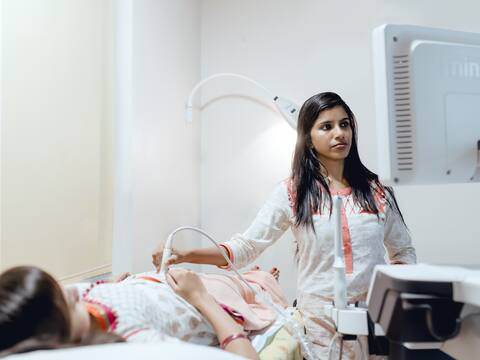
Each scan is a vaginal ultrasound that takes about 5 minutes, needs no preparation and uses no radiation.
You empty your bladder and lie on a couch; a thin probe is placed in the vagina. Most women find it uncomfortable for a few seconds rather than painful. It is safe to repeat, and safe in early pregnancy. You can go straight back to work.
The first scan is on day 2 or 3 of your period, and tracking scans start around day 9 to 10 in a 28-day cycle, then every 2 to 3 days until the follicle releases.
Day 1 is the first day of full bleeding. The baseline scan counts the small resting follicles, rules out a cyst and checks the lining is thin. In a longer cycle everything shifts later: in a 35-day cycle the first tracking scan is closer to day 14. Scans follow your cycle, not a fixed calendar.
A follicular study cannot tell you about egg quality, whether your tubes are open, whether you have endometriosis, or whether fertilisation will happen.
Egg quality follows age: a 20 mm follicle at 27 and at 42 look the same on screen. Tubes need an HSG or HyCoSy. One cycle without release is also normal now and then, even in women who conceive easily; a pattern across 2 or 3 cycles is what matters.
Tube check: HSG and HyCoSyA saline infusion scan (sonohysterogram, SHG) is a vaginal ultrasound with a little sterile salt water passed into the womb, so the inside of the cavity shows clearly.
It looks for polyps, fibroids inside the cavity, scar tissue and an unusual womb shape. A fine catheter passes through the cervix; most women feel cramping for a few minutes. It is done after your period stops and before ovulation. If it finds something, hysteroscopy can confirm and usually treat it.
HysteroscopyBring your scan reports. We read them with you, line by line.
Units: Progesterone is printed in ng/mL or nmol/L (1 ng/mL is about 3.2 nmol/L). Follicle and lining sizes are in mm.

Which day of your cycle the scan was done, counting the first day of your period as day 1.
The small resting follicles counted on the baseline scan. It estimates egg reserve, not quality.
The lead follicle, usually one, that is expected to release the egg. It grows a millimetre or two a day.
The thickness of the womb lining, where an embryo would implant.
The lining shows three lines on the scan, the usual look before ovulation.
The follicle has released its egg and turned into the corpus luteum, which makes progesterone.
A little fluid behind the womb, often seen just after release.
The follicle grew but did not release, or stayed on as a cyst.
A blood test about a week before your next period that confirms ovulation after the fact.
Source of ranges: Ranges from the ASRM fertility evaluation committee opinion (2021), the ASRM ovarian reserve committee opinion (2020) and the ASRM ovulation detection fact sheet. NICE NG257 for confirming ovulation.
IfA follicle matures and releases, lining thickens
You ovulate. We give you the days to try, or book IUI, and move on to the other tests (tubes, semen analysis, AMH).
What that meansIfNo follicle reaches mature size
You are not ovulating this cycle. We look for the cause (often PCOS or thyroid) and start or adjust ovulation tablets.
What that meansIfMany follicles grow on tablets
Too many follicles means a risk of twins or more. The cycle may be cancelled and the dose lowered next time.
What that meansIfA follicle matures but does not release
Once is common. If it repeats, a trigger injection can release the egg at a set time, and timing is planned around it.
What that meansIfThe lining stays thin
We repeat the scan, review the tablet used, and check the cavity with a saline scan or hysteroscopy if needed.
What that meansA follicular study helps if one of these is you.
Regular cycles and no treatment planned? Start with the basics of tracking ovulation at home.
Your cycle length, any tablets you've taken, and past scan reports.
A baseline scan on day 2 or 3, and his semen analysis the same week.
Which days to scan, and what each scan result will decide.
Timed intercourse, IUI or a trigger injection, with a limit on how many tracked cycles.
Most follicles release the egg at about 18 to 25 mm, according to ASRM. Size shows maturity, not egg quality, and IVF uses different sizes for a different purpose, so don't compare an IVF report with a natural-cycle one.
Usually 3 or 4 in a regular cycle, sometimes 5 if ovulation is late. Once one cycle's pattern is known, later cycles usually need fewer.
Try that day and the next two days. Release usually follows within 24 to 48 hours of maturity, and sperm can survive for up to three days.
No, a follicular study is usually uncomfortable for a few seconds rather than painful. It uses no radiation and is safe to repeat.
A follicular study is more accurate than an ovulation kit, but for regular cycles a kit is usually enough. Scans are worth it when tablets, IUI or irregular cycles are involved.
The scan before a frozen embryo transfer checks that the womb lining is thick enough and has the right pattern, and that there is no cyst or fluid. It decides the transfer date.
Yes, the baseline scan is done during your period, on day 2 or 3. Tracking scans come later, from around day 9 to 10 in a 28-day cycle.
The questions people don't ask with their partner sitting beside them, answered by Dr Vani Sundarapandian.
If you're looking for a clinic that offers not just expert care but also emotional support, Jananm Fertility Clinic is the place to go. Thank you, Dr. Vani, and the wonderful team.
After five years of struggle and countless emotional ups and downs, your unwavering support and expertise have been a beacon of hope for us. Dr. Vani mam and her team have shown incredible dedication to our journey.
Send us your cycle length and any scan reports you have. Janvi, Jananam's companion for fertility treatment, replies straight away.
Chat on WhatsAppCall +91 89399 94244Read the Jananam Standard